
Morris-Cotterill: The scale of fraud on LinkedIn is incalculably huge. And the company connives in it.

They are easy to spot. Many create a false CV, often consisting of a highly regarded university and a single well known company. They repost something legimate and then post the comment described above.
The first type, those that post in groups and thus bombard the feeds of those members of groups that have not yet turned off notifications are exploiting the recent change, by LinkedIn, to make all groups public. This has resulted in many group admins, who are of course unpaid as they set up the groups for promoting their own companies or simply to help others, removing approvals. The fraudsters then post, at high frequency, the same message across multiple groups, suggesting the use of bots.
That first type is enormously successful at posting messages for e.g. "free lean Six Sigma" courses, for high priced "reports" often using the power of redirection by including an image or video that's interesting but unrelated to the pitch. When I say "enormously successful" I'm not talking about the money they make because I don't know but I am talking about the fact that I see dozens of such fraudulent posts daily and report many to LinkedIn which in the year or so since I started doing this has taken no action to prevent either the fraudulent accounts or the posting of such messages.
The second type is growing rapidly. At least one of them posts a comment on at least one of my messages most days. Sometimes the bot's algorithm shows its flaws and the same fake leaves the same message on several of my posts in a single day.
Below is an example of the profile of one such case. GSK is GSK Solutions Inc, a company that is not related to GSK as in GlaxoSmithKline UK Limited the 200 year old Pharmaceutical company headquartered in the UK under the name GSK PLC.
In its LinkedIn profile, GSK Solutions says "GSK Solutions Inc. is a cutting-edge, no-nonsense cybersecurity company that provides security software, services, and consulting to companies looking for an affordable, reliable solution." The company's profile is here: https://www.linkedin.com/company/gsk-solutions-inc and the "people list" is fascinating. According to its website, it has offices in three locations in the USA, Texas (HQ), Oregan and Virginia plus a "development centre" in India.
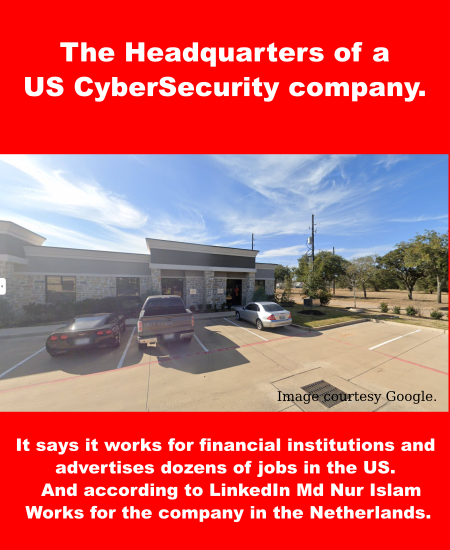
This is the Google search image of the Texas headquarters where the company has a "suite". In US-speak, that usually means a post box. Its US phone number is a 959 number that resolves to Hartford, Connecticut .
It does not have an office in the Netherlands. Its website includes a "scam alert" about fake jobs but contains no information as to the officers of the company or senior staff. It's laden with stock images and contains some quite well written but has lots of words with not much substance – and some very random grammar. Its "Clients" page contains no information as to clients. It contains 155 jobs, many in the US in locations where there is no office listed. But there are none in The Netherlands.
From both its LinkedIn page and it's website, it's impossible to tell if this is a genuine company. There are no company registration details on its website and LinkedIn never checks that information.
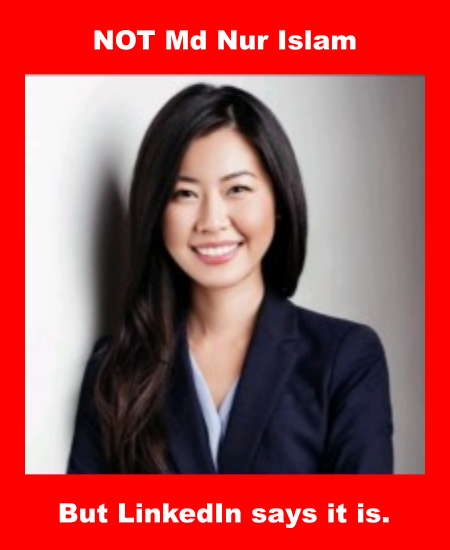
I did a Google reverse image search for that photo and I stopped counting at 17 identical photos on LinkedIn on the first page of I don't know how many. There were also two very similar photos. Samples: there's Smriti Gupta, Gina Bosse, Jessica Middleton, Charlene Ong (Same photo on RocketResearch but a very similar one on LinkedIn, Samantha Ashby, Tasya Assahra, YEE Fei Yong, Natalie Leong, Kim Chan, LEOW Yi Lang and more.
They are in the USA, Singapore, Malaysia, the UK and Taiwan and more. They are in HR, lawyers, administrators and an air stewardess. And the work for the UK's Department of Defence, Boeing Defence, Space and Security, Banks and and a host of other business types.
LinkedIn says that there are 200+ profiles using the name Md Nur Islam. Some of them are real and can be easily identified from.. oh, wait. Facebook has millions of fake accounts so double checking there, via a search engine, isn't reliable either.
And I don't understand how TikTok search works – it says it has more than six million posts in some way related to that name.
Nothing I've uncovered required more than a few seconds research using the most open of open source sources – google. Nothing indicates a false positive (with the caveat that I still can''t be sure about GSK Solutions but there is enough to make me want to find out more if I were considering dealing with them).
We often hear that LinkedIn should not be used for any form of verification. Even its own verification system is flaky. But do we really know how high-risk it is to use it for even the most basic quick checks? I do and I know what to look for. Do you?
The biggest annoyance is that it's very, very easy for LinkedIn to prevent these fraudulent accounts and posts. This is not wilful blindness because I've told it. It's a deliberate failure to put in place measures to protect decent, honest and truthful people.
That burden falls on its management and its owners, Microsoft.
I can fix it. But when I've suggested it consult me, LinkedIn ignores me. It even blocked me and demanded that I verify I was me (which is how I know their verification is flaky).
So we know the persistence of obvious fraud on LinkedIn results from a policy decision and that must mean that a profit is being made from aiding such criminals.


About this section
Opinion pieces or "Op-Eds" are the home-made bombs of the publishing world. So long as they meet editorial standards, are not intentionally offensive with a view to causing hurt or insult and are relevant to our field of endeavour, we will look at submissions.
We like contentious, we like contrarian views. We don't like pretty much any -ism . We recognise that Opinion pieces are one person's view and are not balanced (if they are balanced and reach a reasoned conclusion, they are probably more suited to the Articles section). We do not like acronyms and buzzwords.
Op-Eds are the author's personal views and do not necessarily represent the views of World Money Laundering Report or its publishers.
To submit an Opinion piece, please complete the Contact form.
