

UK Government to Fluff Proceeds of Crime Act?

First, the Queen's Speech, read at the official opening of the new Parliament, contained only 15 proposals - said by commentators to all but confirm that the Government is going to go for a spring election as the legislative programme is too short to fill a full year. Yet those same commentators also say that the programme is unlikely to be completed before an election even if it does not take place until early summer - and that some of the measures announced will be either quietly dropped or will run out of time. The important thing, say some, is that the Government will be perceived to be doing something about popular issues and that the impending election will mean that those who would seek to modify, frustrate or vote down the legislation would risk offending the electorate by standing up to the Government.
One of the measures expected to go nowhere is the proposed legislation to beef up the UK's existing legislation to confiscate proceeds of crime.
The process of producing legislation in the UK is that a Bill is introduced into Parliament, usually into the House of Commons but sometimes into the House of Lords. The Bill is debated in one house, then the other, shuttling back and forth until it goes into "Committee" when it is considered by all parties in a somewhat less public (and therefore less histrionic) fashion. It is eventually passed and then receives the Royal Assent whereupon it becomes an Act. Discussion papers are Green Papers and White Papers.
So, no one is quite sure what a Draft Bill is, in Parliamentary terms. But whatever it is, the Home Secretary is going to introduce one. It is unlikely that something more further away from an Act than even a Bill stands any change of gaining Royal Assent in this Parliament, unless it can be in some way fast tracked.
That seems unlikely. The Cabinet Officer paper (which appears on the Cabinet Office website) has a foreword by Call-me-Tony Blair who emphasises his grasp of the importance of the topic by saying of money launderers "they provide bad role models for young people."
More significantly, however, he says that the objective of separating criminals from the proceeds of their crimes "will need to be achieved in a way that respects civil liberties; we will ensure that is the case."
This latter point is the reason that the Bill (if it ever becomes one) is most likely to run into trouble.
There have been a number of decisions by Courts around the world in the past few months that have thrown cold water on civil forfeiture, especially before conviction.
Even in the USA where the idea of asset seizure was first applied, the tide has begun to turn against it.
And so, it may well be that a delay in making substantial changes to the law relating to asset seizure may well be prudent - after all, there is no point in making laws that are promptly overturned by the Courts.
The UK has recently brought into effect the principles of the EU's Human Rights Directive. This has put the legislature on the back foot - and, worse, has effectively given the Courts power to re-write existing statute law. There is a feeling abroad that any attempt to use civil forfeiture before conviction would create a civil rights challenge.
Civil rights campaigners in the USA have succeeded in having such polices overturned or suspended in at least one state and more challenges are expected. The USA has operated civil forfeiture for several years and it has been very successful. Linda Candler - at one time with the Department of Justice in California and now in private practice - has said that the procedure was simple - freeze the assets and tell the target they can have them back when he proves legitimate ownership of the asset or the funds that provided it. Not many bother to apply to get them back, she says.
The scale of the problems that the UK's Cabinet Office seeks to deal with are emphasised by establishing that the powers to detain currency discovered leaving the country apply only to that which customs officers believe to be the proceeds of drugs trafficking - so proceeds of any other offence are not liable to confiscation at ports.
Furthermore, the government accepts that confiscation after conviction has so far been the exception rather than the norm and wishes to change the emphasis. In doing so, it will create a directorate within the Home Office. This is an interesting development but one that seems flawed - there are several main reasons why confiscation is not generally successful - first is lack of police manpower to identify assets, second is the reluctance of judges to be pragmatic, third is that the criminals have often been able to conceal assets long before trial and fourth is that there is insufficient centralisation of information to enable asset tracking.
So, the following measures make more sense: the new directorate should ideally form a part of NCIS, the UK's FIU because NCIS already has a brief to collate at least a part of the information required. So far, police forces do not push information of the type needed up to NCIS, preferring to receive rather than give information; second NCIS needs to be properly resourced (it never has been - it is a truly shoestring operation) and it needs to have allocated to it an investigation team to examine and provide forensic support to prosecuting authorities (including regional police forces); judges need to told that financial and white collar crime, including laundering, is as much a threat to society as hitting little old ladies over the head to steal their handbags - and to sentence accordingly - and that confiscation is a valuable part of the process.
Finally, police forces need to be made to centralise information. There is a common database (and a new NCIS database into which a quarter of UK police forces pass information) but the information needs to be more detailed and more up to date, especially insofar as financial information is concerned. The UK's regional police force system means that assets in another part of the UK can be effectively concealed.

But, even more important than this, is that some way has to be found to reconcile the conflicting aims of human/civil rights with those of society at large to enable the freezing of assets prior to trial. Without that base position, there is little point in having the best constructed confiscation process. Because the assets will have disappeared before charges are brought.
The Cabinet Office also drew attention to the disparity of reporting between different types of business. Company formation agents are not subject to the 1993 Money Laundering Regulations as a result solely of that activity. However, the other named classifications are.
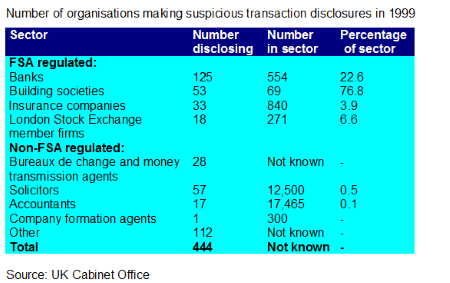
The Cabinet Office paper has much to commend it. For example, it clearly states the Government's view of who is bound to do what under the existing law. It is at www.cabinet-office.gov.uk


